
Blog
Gas Lift Ottoman vs Side-Opening Ottoman: Which Storage Bed Is Better?

You’ve decided you want an ottoman bed. Smart choice.
The storage capacity alone makes it one of the most practical bedroom purchases available for UK homes: hundreds of litres of hidden space, a clean modern look, and a bed that genuinely earns its place in your room every single day.
But then you start looking at the options and a new question appears. Gas lift ottoman or side-opening ottoman? End-opening or side-opening? What’s actually the difference, and does it matter enough to change your decision?
The short answer is: yes, it matters. Quite a lot, actually.
Choosing the wrong opening configuration for your specific bedroom layout means storage you can barely access, a mattress you’re fighting to open, or, in the worst case, a bed that physically cannot open at all because the clearance simply isn’t there.
Choosing the right one, on the other hand, makes the whole thing effortless. A gentle lift, the mattress rises smoothly, you access everything underneath, and it closes quietly without drama.
This guide explains everything clearly, honestly, and with the specific detail that most buying guides skip over, so you choose the right ottoman bed frame configuration for your bedroom from the very start.
First: What Do These Terms Actually Mean?
Before we compare them, let’s make sure we’re using the right language, because gas lift ottoman and side-opening ottoman are not actually opposites. They describe different aspects of the same product.
Here’s the important distinction:
- Gas lift refers to the mechanism, the gas pistons that do the heavy lifting work. Almost all modern ottoman beds use gas lift technology. It’s not a style or configuration choice; it’s simply the name for how the lifting works.
- Opening direction refers to which way the mattress lifts, from the foot end (end-opening) or from one side (side-opening). This is the genuine choice that affects how the bed fits in your room.
So when buyers ask gas lift ottoman vs side-opening ottoman, what they’re really asking is: end-opening ottoman vs side-opening ottoman. Both use gas lift pistons. The difference is simply which direction the mattress goes when it opens.
That’s the comparison this guide focuses on, because it’s the one that actually matters for your bedroom.
How Gas Lift Mechanisms Work
Understanding how the gas lift works helps you appreciate why opening direction matters, and what to look for in a quality ottoman bed frame.
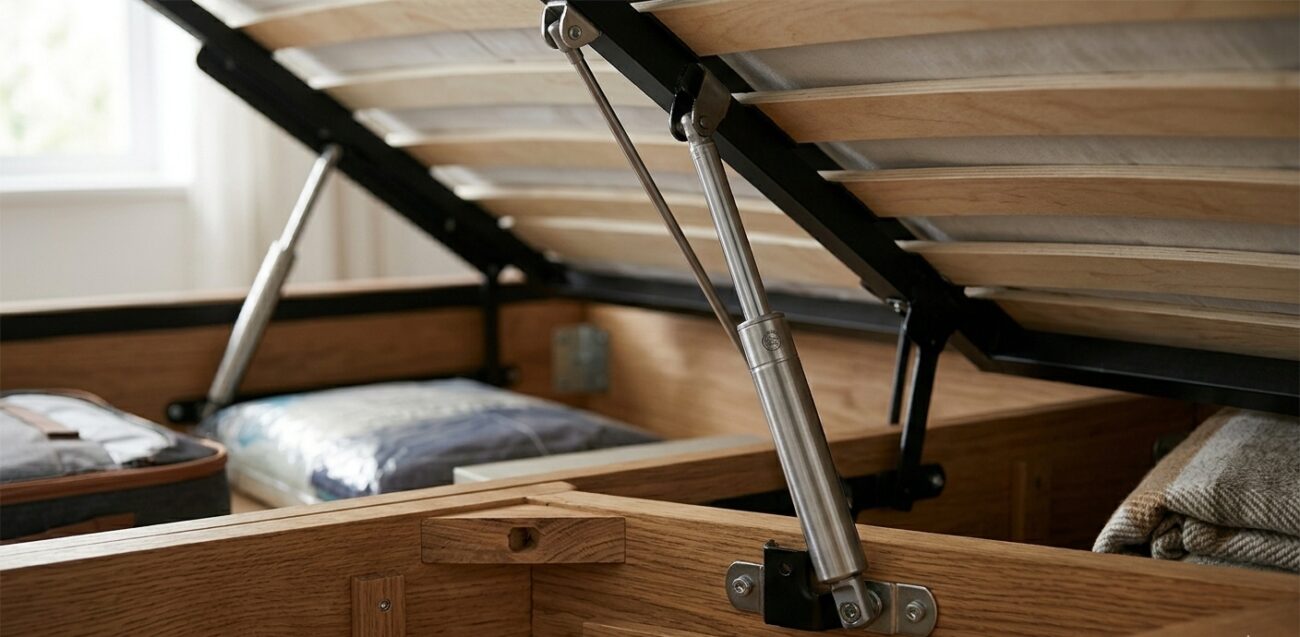
A gas lift mechanism consists of two or more gas-charged pistons, similar in principle to the mechanism that holds your car boot open. The pistons are mounted between the bed base and the mattress platform. When you apply upward pressure to the mattress (or a designated lift handle), the gas pressure in the pistons assists the lift, taking most of the weight.
The mattress rises to a stable, fully open position and stays there without any support from you. When you’re ready to close, you pull the mattress back down, the pistons compress slowly, and the base closes gently and quietly.
The quality of this mechanism varies significantly between products:
Signs of a Quality Gas Lift Mechanism:
- Opens smoothly with minimal effort, one hand, gentle push
- Holds fully open at a stable angle with no drift or wobble
- Closes slowly and gently, does not drop suddenly
- Operates quietly with no grinding or resistance
- Rated for thousands of open-close cycles
Signs of a Poor Gas Lift Mechanism:
- Requires significant force to open
- Doesn’t hold fully open, starts to drift down
- Closes suddenly or drops with a bang
- Develops resistance or noise within months of purchase
According to Which?, the gas lift mechanism is the component most likely to vary in quality between budget and mid-range ottoman beds, and checking the mechanism warranty is one of the most reliable quality indicators. Look for a minimum 2-year guarantee; quality manufacturers offer 3–5 years.
End-Opening Ottoman Beds: Everything You Need to Know
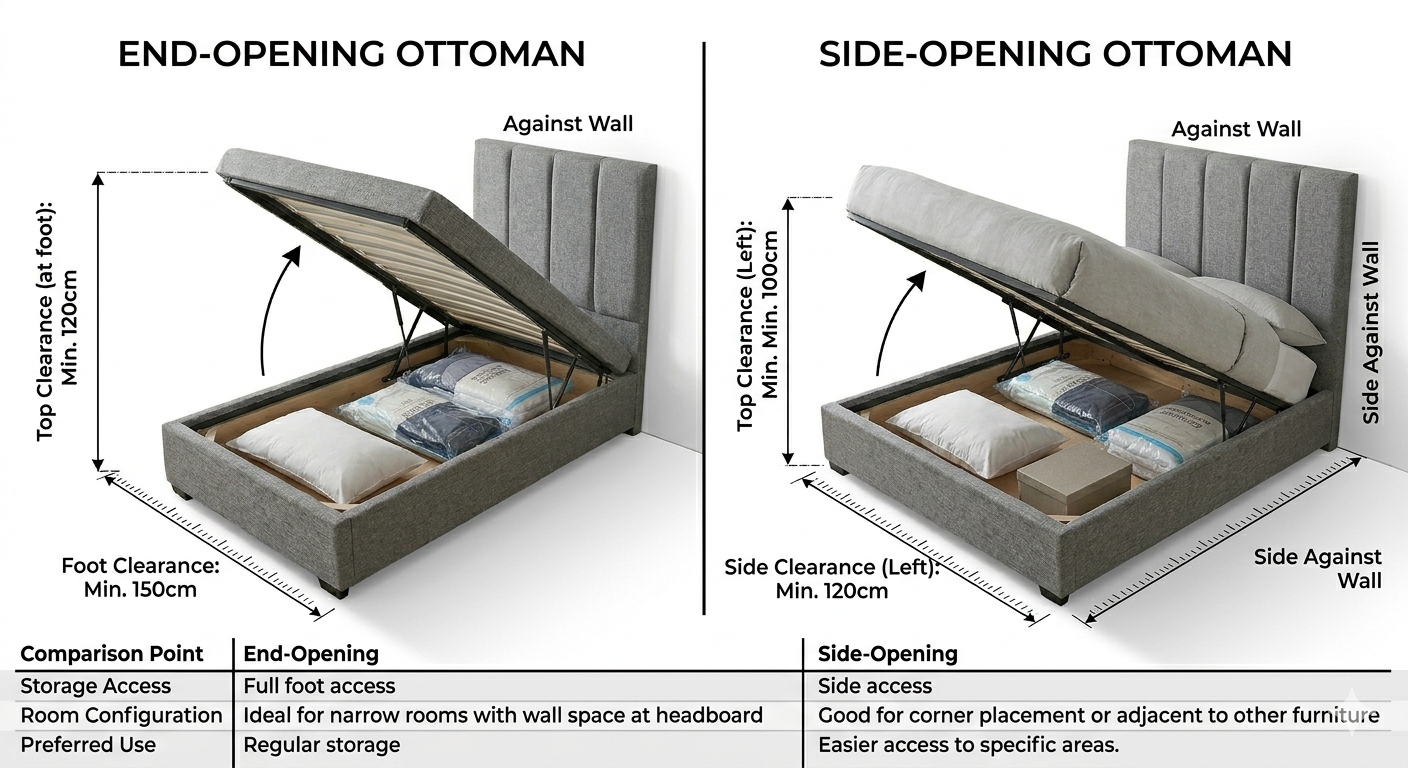
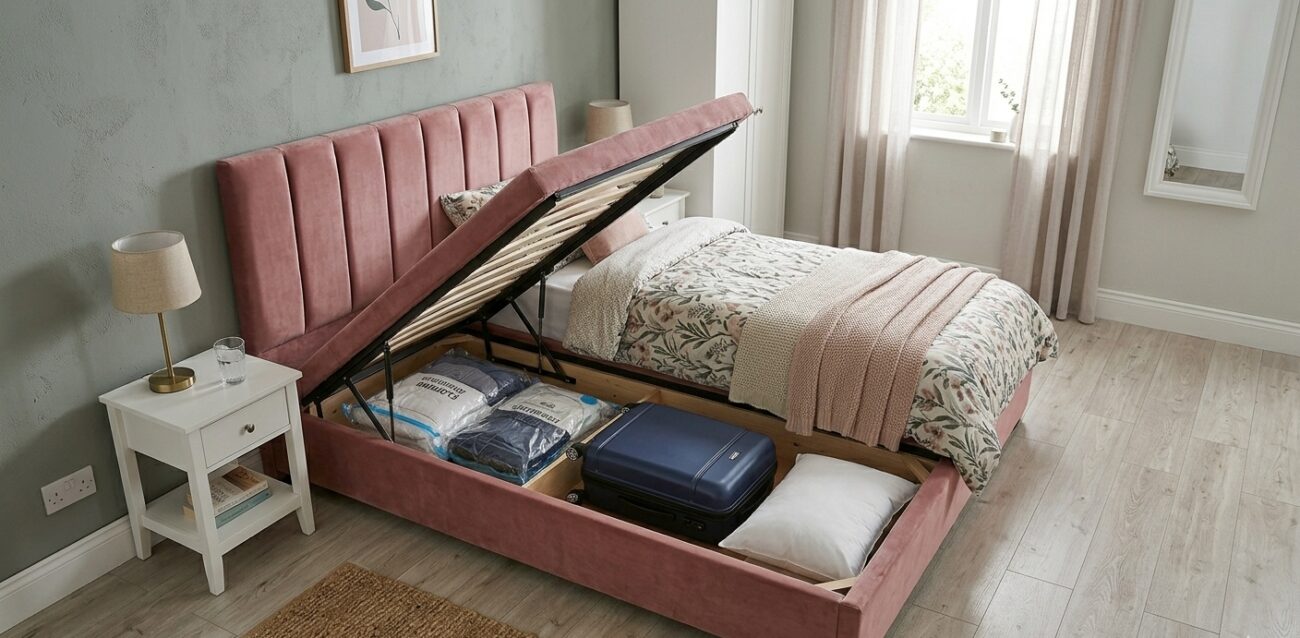
An end-opening ottoman bed lifts from the foot end of the bed. When you open it, the mattress swings upward toward the wall at the head end, like the lid of a chest freezing open from the front.
How It Works
The gas pistons are positioned at the foot end of the base. When you lift the mattress from the foot, the pistons assist the motion and the mattress rises to a stable open position, pivoting around a hinge point near the head of the bed. The entire under-bed area is then accessible from the foot end.
The Advantages of End-Opening
- Natural room positioning. The vast majority of UK bedrooms have the bed positioned with its head against the main wall. End-opening ottomans are designed exactly for this layout; the head end is fixed against the wall, the foot end has clear space, and the mattress opens naturally into that space.
- More intuitive to use. Standing at the foot of the bed to lift the mattress feels natural; it’s the position most people occupy when making the bed or accessing storage anyway.
- Wider opening arc. Because the mattress pivots from the head end, the full width of the storage area is immediately visible and accessible when open. You can see and reach everything from one position at the foot.
- Cleaner visual profile. End-opening ottomans typically have a symmetrical look from all sides, no visible side mechanism housing, which can give the ottoman bed frame a cleaner, more seamless appearance.
The Disadvantages of End-Opening
- Requires clear space at the foot. This is the critical requirement. The mattress needs to swing upward and outward at the foot end, which means you need approximately 60–80cm of clear space beyond the foot of the bed. If a wardrobe, chest of drawers, or wall sits close to the foot of the bed, the mattress cannot open fully, or at all.
- Less suitable for alcove or recess positions. Bedrooms where the bed sits in an architectural recess often have restricted foot-end clearance, making end-opening configurations awkward.
- Access from one direction only. All storage access happens from the foot end. If you need to reach something stored near the head end of the base, you’re leaning in further than you might like.
Who Should Choose End-Opening?
End-opening is the right choice if:
- Your bed’s head end is against a wall (the most common UK bedroom layout).
- The foot of the bed has at least 60–80cm of clear floor space.
- No wardrobe, wall, or furniture sits close to the foot of the bed.
- You want the most intuitive, natural-feeling opening experience.
- Visual symmetry of the base is important to you.
Side-Opening Ottoman Beds: Everything You Need to Know
A side-opening ottoman bed lifts from one side, either the left or the right, specified at the point of purchase. When opened, the mattress swings upward away from the chosen side, pivoting around a hinge point on the opposite side.
How It Works
The gas pistons are positioned along one side of the base, the opening side. When you lift the mattress from that side, the pistons assist the motion and the mattress rises to a fully open position, pivoting around a hinge point on the opposite side. The under-bed storage is then accessible from the opening side.
The opening direction, left or right, must be specified when ordering because the piston configuration is fixed during manufacture. This cannot be changed after delivery, so choosing correctly before you order is essential.
The Advantages of Side-Opening
- Works when the foot end is restricted. If your bedroom has a wardrobe, window, wall, or radiator close to the foot of the bed, a side-opening configuration solves the problem entirely. The mattress opens sideways instead, requiring only 60–70cm of clearance on one side.
- More flexible room placement. Side-opening ottomans work in a wider variety of bedroom layouts, including rooms where the bed sits in a recess, adjacent to a fitted wardrobe, or in a corner arrangement.
- Accessible from the sleeping side. If the opening side is the side you sleep on or stand beside regularly, access is extremely convenient; the storage is immediately in front of you.
- Better for narrow rooms. In a bedroom where the foot-end clearance is minimal but one side of the bed is fully accessible, side-opening is often the only practical choice.
The Disadvantages of Side-Opening
- Requires clear space on the opening side. Just as end-opening needs foot-end clearance, side-opening needs at least 60–70cm on the opening side. If both sides of the bed are close to walls or furniture, neither configuration works.
- Commit to the opening direction before ordering. Unlike end-opening, where both sides of the mattress behave identically, side-opening requires you to choose left or right at the point of purchase. Getting this wrong means the mattress opens toward a wall, which is equally unusable as no clearance at the foot.
- Less of the storage is immediately visible. When a side-opening ottoman is open, you’re looking along the length of the storage area from one side; some items stored at the far end can be harder to see and reach than in an end-opening configuration.
- Can look slightly less symmetrical. The side mechanism housing is sometimes slightly visible on the opening side of the base, a minor aesthetic consideration but worth noting for buyers who care about every visual detail.
Who Should Choose Side-Opening?
Side-opening is the right choice if:
- The foot of the bed is close to a wall, wardrobe, or other obstruction.
- One side of the bed has at least 60–70cm of clear, accessible space.
- The bed sits in an alcove, recess, or against a fitted wardrobe.
- You can clearly identify which side (left or right) will be the opening side before ordering.
- The bedroom layout makes end-opening impractical.
Direct Comparison: End-Opening vs Side-Opening
Feature End-Opening Ottoman Side-Opening Ottoman Lift direction From foot of bed From left or right side Clearance needed 60–80cm at foot 60–70cm on opening side Best room layout Head against wall, clear foot space Foot restricted, one side clear Opening feel Very natural and intuitive Slightly less intuitive initially Storage visibility Full width visible from foot Length visible from one side Pre-order choice needed No, symmetrical Yes, must specify left or right Mechanism position Foot end of base Chosen side of base Visual symmetry Fully symmetrical Minor asymmetry on mechanism side Room flexibility Works in most standard layouts Works in more restricted layouts Best for Standard UK bedroom layouts Alcoves, recesses, fitted wardrobes
What to Look for in an Ottoman Bed Frame
Regardless of opening direction, the quality of the ottoman bed frame itself determines how well the bed performs and how long it lasts. Here’s what matters most.
Internal Frame Construction
The base frame, the structure inside the fabric covering, is the foundation of everything. Quality ottoman frames use solid timber construction with high-density foam padding. Budget frames use thin chipboard or composite materials that compress and deteriorate faster.
Ask specifically about internal frame materials. A reputable retailer will always have this information. If they can’t tell you what’s inside, that’s informative in itself.
Piston Quality and Specification
Not all gas pistons are equal. Quality pistons are rated for thousands of open-close cycles, typically 10,000 or more, and are made from materials that maintain their pressure over time. Budget pistons lose tension faster, become stiffer to open, and may start dropping before they’re fully closed.
The mechanism warranty is the most accessible quality indicator: 2 years minimum, 3–5 years for quality products.
Base Depth
Internal base depth, the vertical distance from the floor to the underside of the mattress platform, determines what you can actually store. Quality ottoman frames typically offer 28–38cm of internal depth. Deeper bases store more and accommodate larger items.
Always ask for the internal depth measurement, not the overall base height, which includes frame thickness and overstates the usable space.
Fabric Quality
The upholstery of your ottoman bed frame is visible in your bedroom every day. Quality fabric resists pilling, fading, and small tears for significantly longer than budget options. Velvet, chenille, and quality woven fabrics all have different maintenance requirements; choose based on your lifestyle and how much care you’re prepared to give.
Split Base Configuration
All ottoman bed bases split into two sections for delivery; this is standard and makes getting the bed into UK homes with narrow staircases and tight hallways dramatically easier. Check that the split point is clearly indicated and that the two sections connect securely before placing the mattress.
The Most Important Question to Answer Before You Order
Everything in this guide leads to one practical question you must answer before ordering any ottoman bed:
Where does the mattress go when it opens?
Stand in your bedroom. Physically stand at the foot of the bed and look at what’s there. Is there 60–80cm of clear space? If yes, end-opening works.
Now stand at each side of where the bed will be. Is there 60–70cm of clear space on either side? If yes, side-opening works, and you know which side to choose.
If neither the foot nor either side has adequate clearance, an ottoman bed won’t work in that room configuration. In that case, a divan bed with drawers is the practical alternative and still offers far more storage than a standard bed frame.
This single question, answered honestly with a tape measure in hand, prevents the most common and most expensive ottoman bed buying mistake.
Conclusion: Both Are Excellent, the Right One Depends Entirely on Your Room
The gas lift mechanism in a quality ottoman bed frame is one of the most satisfying storage solutions available for any UK bedroom. Whether end-opening or side-opening, the experience of lifting a mattress smoothly to reveal hundreds of litres of perfectly organised storage underneath never really gets old.
The difference between end-opening and side-opening is not about quality, storage capacity, or comfort. It’s purely about which direction the mattress can physically go in your specific bedroom.
Measure your room. Check your clearances. Identify your layout. Then choose accordingly, and enjoy a storage bed that works exactly as it should, every single time.
Ready to find your perfect ottoman bed frame? Visit our full Ottoman Bed collection at Appex Beds, end-opening and side-opening configurations available in every size, in premium upholstered fabrics, with free UK mainland delivery on every order.
Frequently Asked Questions
What is the difference between a gas lift ottoman and a side-opening ottoman?
Gas lift describes the mechanism, the gas-charged pistons that assist the mattress in lifting. Almost all modern ottoman beds use gas lift technology. Side-opening describes the opening direction, the mattress lifts from one side rather than the foot end. Both types use gas lift pistons; the real choice is between end-opening (lifts from the foot) and side-opening (lifts from one side).
How much clearance does an end-opening ottoman bed need?
An end-opening ottoman bed frame needs approximately 60–80cm of clear floor space at the foot of the bed for the mattress to lift fully and safely. The exact clearance depends on the specific bed length and mattress thickness, always check the product specification for the recommended minimum clearance before ordering.
Can I change an ottoman bed from end-opening to side-opening after delivery?
No. The gas piston configuration is fixed during manufacture, end-opening pistons are positioned at the foot end, and side-opening pistons are positioned along one side. This cannot be changed after the bed is built. It is essential to identify your required opening direction before ordering. For side-opening models, you must also specify left or right opening at the point of purchase.
Which opening type is better for a fitted wardrobe bedroom?
Side-opening is almost always better for bedrooms with fitted wardrobes at the foot of the bed. End-opening requires clear space at the foot, which a fitted wardrobe eliminates entirely. A side-opening ottoman bed frame configured to open on the opposite side from the wardrobe resolves this completely, as long as that side has at least 60–70cm of accessible clearance.
How long does a gas lift ottoman bed mechanism last?
A quality gas lift mechanism in a well-made ottoman bed frame should last the full lifespan of the bed, typically 8–12 years with normal use. Quality pistons are rated for 10,000 or more open-close cycles. The most reliable quality indicator is the warranty: look for a minimum 2-year guarantee on the mechanism, with quality manufacturers offering 3–5 years. Avoid products with no stated mechanism warranty.