
Blog
How Long Should a Bed Base Last? (And How to Know When Yours Needs Replacing)

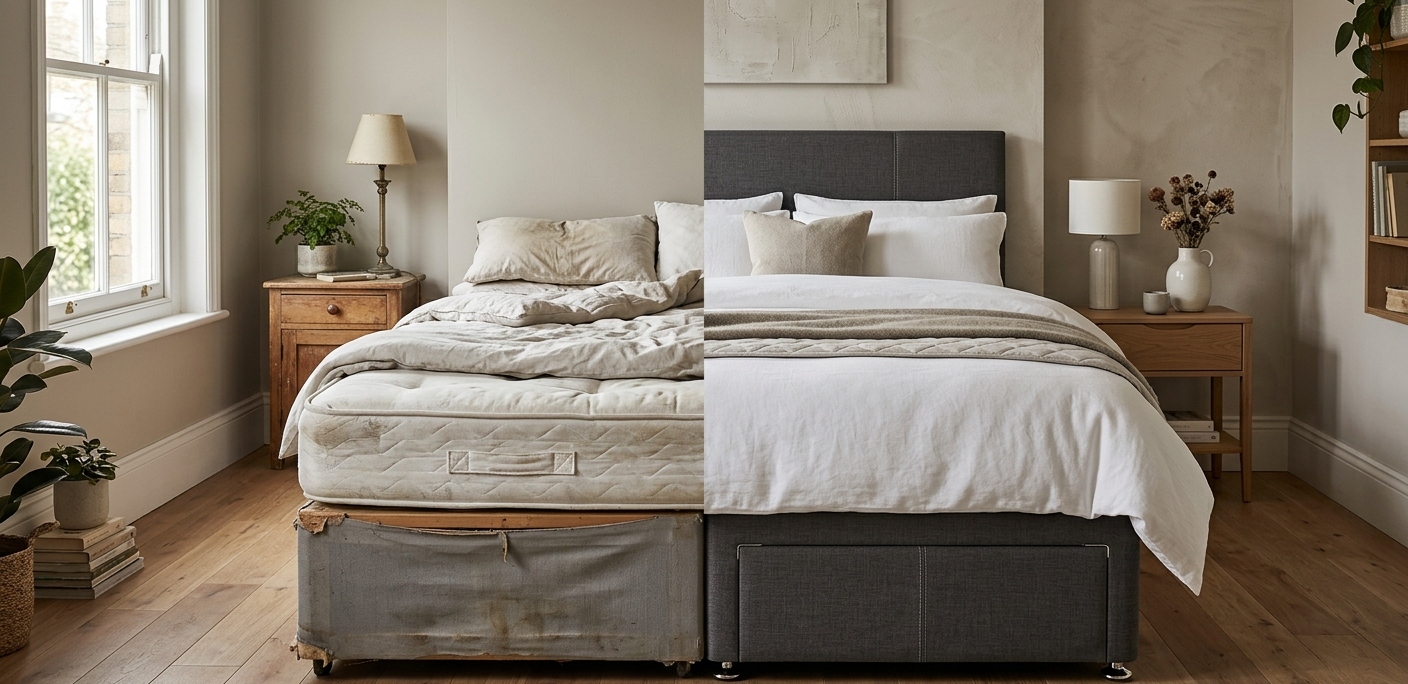
Most people replace their mattress when it starts causing problems. Fewer people think to question the base underneath it.
And that is a mistake that costs more than most buyers realize.
A bed base that is past its useful life does not just look tired. It actively undermines the mattress resting on top of it. A sagging or unstable base changes the support profile of even a brand new mattress, which means you could buy an excellent replacement mattress and still wake up with a sore back because the base is not doing its job properly.
Understanding how long a bed base lasts in the UK, what affects that lifespan, and how to recognize when replacement is genuinely necessary is one of the most practical things a buyer can know before making any bedroom purchase decision.
This guide gives you honest, clear answers to all of it.
The Short Answer: How Long Does a Bed Base Last?
There is no single number that applies to every bed base because lifespan depends heavily on construction quality, materials, how frequently the bed is used, and how much weight it supports night after night.
But there are realistic ranges based on quality tier that most buyers can use as a reliable guide.
Quality Tier | Typical Lifespan | What It Looks Like |
Budget | 3 to 6 years | Thin chipboard internals, basic fabric, plastic runners |
Mid-range | 6 to 9 years | Composite or basic timber frame, moderate fabric quality |
Quality | 9 to 14 years | Solid timber frame, quality upholstery, metal drawer runners |
Premium | 12 to 18 years | Hardwood construction, premium fabric, long warranty |
These are realistic estimates for a bed used by one or two adults every night. A base in a guest room used occasionally will last considerably longer. A base supporting two heavier adults in daily use will reach the lower end of its range faster.
According to the Sleep Foundation, most sleep system components have a functional lifespan that degrades gradually rather than failing suddenly. This is exactly why so many people continue sleeping on a base that has stopped performing well the deterioration is too gradual to notice on any given night.
Why Bed Base and Mattress Lifespan Are Not the Same Thing
This is one of the most common sources of confusion for UK buyers, and it is worth addressing directly before anything else.
The mattress and the base age at different rates. They have different components, different materials, and different failure modes. It is entirely possible to have a mattress that needs replacing while the base remains structurally sound. It is equally possible and more commonly overlooked to have a mattress in reasonable condition sitting on a base that has deteriorated past the point of providing proper support.
Most buyers replace a mattress when they notice it causing discomfort. Fewer buyers think to replace the base at the same time, and even fewer replace the base when it fails while keeping the mattress.
The practical rule is this: Evaluate the base and mattress separately when either one raises concerns. Do not assume that because one is fine, the other must be too. And do not assume that a new mattress will resolve sleep quality issues if the base underneath it is no longer providing a stable, even platform.
A general industry guideline, supported by the National Bed Federation, is to consider replacing the entire sleep system base and mattress together every seven to ten years for a daily-use main bedroom bed. This is a starting point rather than a rule, and quality construction extends that timeline significantly.
The 7 Signs Your Bed Base Needs Replacing
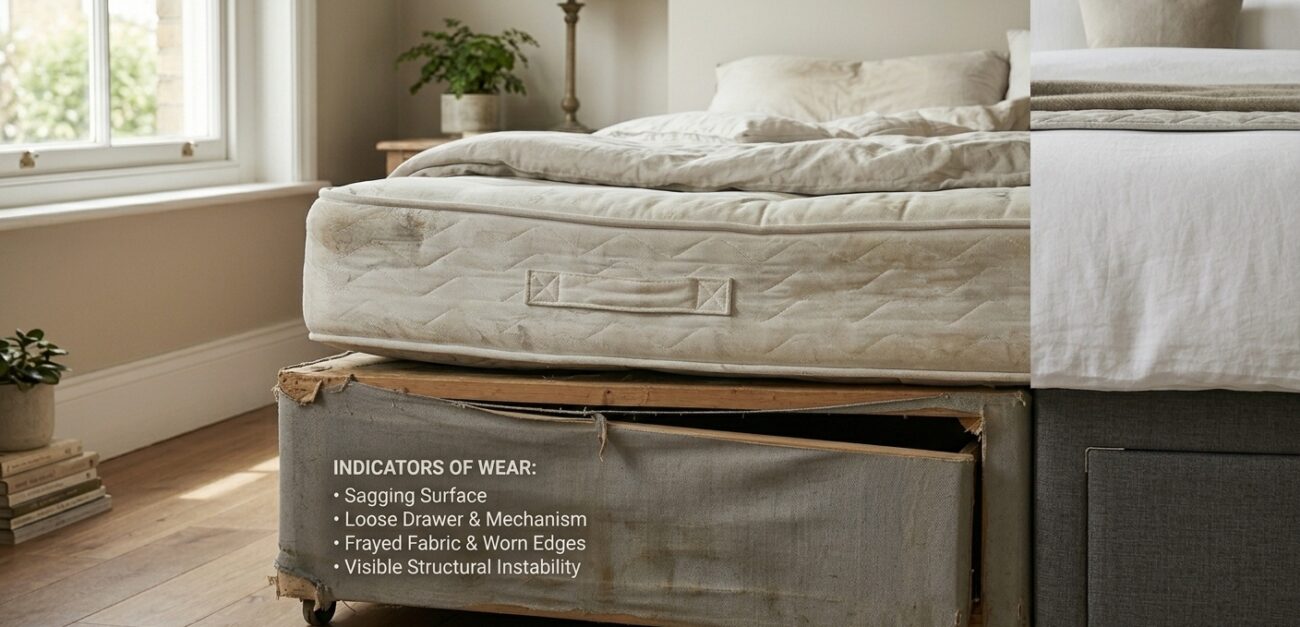
These are the specific warning signs that tell you a base has reached the end of its useful life. Some are obvious. Some are easy to dismiss or adjust to without realizing what is happening. All of them matter.
Sign 1: Creaking or Noise When You Move
A well-made divan base should be completely silent under normal use. If your base has developed creaking, clicking, or any sound when weight shifts during the night, the internal structure is telling you something important.
For divan bases, this typically means the internal timber frame has developed movement at its joints, the base connector bar between the two sections has loosened, or the castor fixings have developed play. Some of these issues are fixable with a simple tighten. But if the noise has developed gradually over several years and cannot be resolved by checking the obvious fixings, the internal frame is likely compromised.
Persistent creaking that disrupts sleep or that your partner notices is one of the clearest signals that the base is past its structural prime.
Sign 2: Visible Sagging or Uneven Top Surface
Stand at the foot of the base and look along the top surface from a low angle. It should be perfectly flat. If you can see any dip, bow, or unevenness in the top surface, the internal structure of the base has compressed or shifted.
This is particularly common in budget bases built with thin chipboard internally. Chipboard compresses under sustained loading in a way that solid timber does not, and the compression creates a subtle but consistent unevenness in the support surface. Your mattress sits on that uneven surface every night, and the unevenness transfers through to your body.
If you can see or feel sagging in the base top surface, the base needs replacing. This is not fixable by rotating the mattress or adding a topper.
Sign 3: Drawer Problems That Cannot Be Resolved
For divan bases with built-in storage drawers, the condition of the drawers is a daily-use indicator of the overall base health.
Drawers that have become difficult to open or close after a basic clean of the runners suggest the base geometry has changed. A structurally sound base maintains consistent drawer opening dimensions throughout its life. When the base frame has shifted, bowed, or compressed unevenly, the drawer openings change shape slightly, which is what causes the sticking and resistance.
A drawer runner replacement can resolve some issues. But if the drawer openings themselves have distorted, the problem is the base frame rather than the mechanism, and the base needs replacing.
Sign 4: The Fabric Is Significantly Deteriorated
Surface fabric wear on a divan base is not an automatic reason to replace it. Slight fading, minor surface pills, or small scuffs from normal use are cosmetic rather than structural.
But significant fabric deterioration, particularly along the top edges and corners where the fabric meets the mattress, can allow moisture and debris to penetrate the internal components. Once moisture reaches the internal foam or chipboard layers of a budget base, the internal structure begins to degrade faster than it would in a dry environment.
Heavy fabric wear combined with any of the structural signs above is a strong signal that replacement is the right decision.
Sign 5: Consistent Sleep Quality Decline
This is the most subjective sign and the one most people dismiss or attribute to other causes. But it is also one of the most reliable indicators that a base is no longer performing correctly.
If you consistently sleep better away from home than in your own bed in hotels, guest rooms, or other familiar sleeping environments and this has been the pattern for several months rather than one or two nights, your sleep system is a very likely cause.
A deteriorated base changes the support characteristics of the mattress above it in ways that accumulate gradually. You adjust to the changes without noticing that the baseline has shifted. Sleeping elsewhere reveals the difference.
If this description matches your experience and your mattress is still within its expected lifespan, the base is the component most worth investigating first.
Sign 6: Your Mattress Is Wearing Unevenly
Flip your mattress over or look carefully at the sleeping surface. Is the wear distributed reasonably evenly across the full area? Or are there specific patches that have compressed more than others, particularly in patterns that correspond to where you tend to sleep?
Some mattress wear in sleeping positions is normal. Wear concentrated in patterns that follow slat or frame structure beneath the mattress, rather than body position patterns, suggests the base is creating uneven support. You will typically see this as subtle lines or bands of compression in foam mattresses or as a visible ridge pattern in pocket-sprung mattresses.
If mattress wear patterns do not correspond to your sleeping position, the base is a likely cause of the uneven wear.
Sign 7: Visible Movement or Instability
Sit on the edge of the base in several positions. Stand up and sit down again. Does the base remain completely still, or does it move, shift, or tilt slightly?
A structurally sound base should feel completely stable from every position. Any movement even very slight means the internal frame, the base connector, or the castor fixings have developed play that makes the base mechanically unstable under loading.
This is the most unambiguous structural warning sign and the one that most clearly signals immediate replacement rather than monitoring.

Cheap Divan Base vs Quality: Why the Difference Matters Over Time
The difference between a cheap divan base and a quality one is not primarily visible on the day of purchase. Both are covered in fabric. Both look broadly similar in product photographs. Both will hold a mattress off the floor.
The difference becomes clear over time, and it is substantial.
A budget divan base uses chipboard or thin composite materials internally, basic fabric that pills and fades relatively quickly, and plastic drawer runners that develop friction and resistance within the first few years of regular use. It reaches the lower end of its quality tier lifespan, typically 3 to 5 years, and the deterioration is visible and felt by that point.
A quality divan base uses solid timber internal framing, quality upholstery that resists everyday wear, and metal ball-bearing drawer runners that maintain smooth operation throughout the base’s lifespan. It reaches 10 to 14 years of reliable use before any significant structural concerns develop.
The price difference between budget and quality at the point of purchase is meaningful but not enormous. Spread across the additional years of lifespan that quality construction delivers, the cost per year of use often favors the quality purchase significantly.
A budget double divan base at 200 pounds lasting 4 years costs 50 pounds per year. A quality double divan base at 380 pounds lasting 12 years costs approximately 32 pounds per year. The quality base is cheaper over time while delivering measurably better sleep support and a better bedroom aesthetic throughout.
Should You Replace the Base, the Mattress, or Both?
This decision depends on an honest assessment of both components separately.
- Replace the base only if: The base shows any of the seven signs above and the mattress is less than 7 years old, still provides good support, has no visible sagging, and you are sleeping well in all other respects.
- Replace the mattress only if the mattress is showing signs of wear, sagging, or deterioration and the base is structurally sound, stable, silent, and within the first half of its expected lifespan.
- Replace both if: Both components are showing signs of age, the combined system is over 8 to 10 years old, or you have been experiencing consistent sleep quality issues that cannot be clearly attributed to one component.
The honest advice from the National Bed Federation is to treat the base and mattress as a sleep system and consider their combined age and condition together. Buying a new mattress and placing it on an old base that is showing structural signs of wear is not a sleep system upgrade. It is a half-measure that limits the performance of the new mattress from day one.
What to Look for When You Replace Your Divan Base
When you are ready to replace, these are the quality indicators that determine whether your next base delivers its full expected lifespan.
- Ask specifically about internal frame construction. Solid timber is the quality standard. Chipboard is not. A retailer confident in their product will answer this question specifically.
- Check the warranty. A manufacturer offering two years minimum on the base and drawer mechanism has genuine confidence in the product’s durability. Three to five years is better. No stated warranty is a warning sign.
- Look at the drawer runner specification if storage is part of your requirement. Metal ball-bearing runners maintain smooth operation indefinitely. Plastic runners are a quality compromise that shows up within the first few years of regular use.
- Confirm the fabric quality by requesting a swatch. The fabric covering is the first thing to show wear, and quality fabric resists pilling, fading, and surface damage significantly better than budget alternatives.
To explore replacement options across every size and storage configuration, browse our Divan Base Only collection at Appex Beds for solid platform bases built with the construction quality that delivers the longer end of the lifespan ranges in this guide.
If you are replacing both base and mattress together, our Mattress collection covers compatible options across every firmness level and mattress type, with bundle options available.
For buyers wanting to upgrade to a base with better storage at the same time, our Storage Divan Bed collection offers fully upholstered storage bases with matching headboards in a range of quality fabrics and sizes.
Conclusion: Know the Signs, Replace at the Right Time
A quality bed base is one of those purchases that rewards you every night for years without ever asking for attention. The best bases simply do their job so consistently that you stop thinking about them entirely.
But every base has a lifespan. And sleeping on one that has passed it costs you in sleep quality, in mattress wear, and in the accumulated effect of nights that are less restorative than they should be.
The seven signs in this guide are your early warning system: creaking, sagging, drawer problems, fabric deterioration, sleep quality decline, uneven mattress wear, and visible instability. Any one of them is worth taking seriously. Several of them together is a clear signal that replacement is overdue.
Do not wait for the base to fail dramatically. It almost never does. It simply gets gradually worse in ways that are easy to adjust to and hard to notice until you sleep somewhere else and feel the difference.
When the signs appear, act on them. Your mattress, your sleep, and your mornings will all benefit immediately.
Frequently Asked Questions
How long does a divan bed base last on average in the UK?
The realistic average for a quality divan base used daily in a UK main bedroom is 9 to 12 years. Budget bases with chipboard internal construction typically last 3 to 6 years. Mid-range bases reach 6 to 9 years. Premium bases with solid hardwood frames and quality upholstery can last 12 to 18 years. Daily use by two adults reaches the lower end of each range faster than occasional use or use by a single lighter sleeper.
Can I replace just the divan base without replacing the mattress?
Yes, and it is often the right decision. If your mattress is less than 7 years old, shows no visible sagging, and still provides good support, there is no reason to replace it alongside the base. A new divan base will give your existing mattress a fresh, stable foundation that can extend its remaining useful life while also improving your sleep quality immediately. Measure your current mattress carefully before ordering a replacement base to ensure the sizes match exactly.
What is the most common reason a divan base needs replacing?
The most common reason is internal frame deterioration that creates an uneven or unstable support surface. In budget bases, this is typically chipboard compression over time. In any base, it can also be joint movement at the internal frame corners that develops gradually and eventually creates the creaking and instability that signals replacement is needed. Drawer mechanism failure is the second most common issue, though this can sometimes be resolved by replacing the runners rather than the full base.
Is it worth buying a more expensive divan base for a longer lifespan?
Yes, consistently. The cost-per-year calculation almost always favors a quality purchase over a budget one. A quality divan base at a higher initial price that lasts 12 years provides better value per year of use than a cheap alternative at half the price that lasts 4 years and needs replacing three times in the same period. The sleep quality benefit throughout that period is also meaningfully better with a quality base, which has a genuine daily impact on how you feel and function.
Should I replace my divan base and mattress at the same time?
If both are showing signs of age or both are over 8 to 10 years old, replacing both together is the right approach. A new mattress on an old base that has structural issues will underperform from day one. A new base under an old mattress that is sagging or deteriorated will not resolve the mattress problems. When both components are at or past the useful end of their lifespan, treating them as a sleep system and replacing both gives you the full benefit of the investment.