
Blog
The Ultimate Ottoman Bed Buying Guide UK: Everything You Need to Know

Buying a new bed is one of those decisions that feels simple until you actually start doing it.
And ottoman beds, for all their obvious appeal, come with more questions than most. What opening type do I need? Which size is right for my room? Does the gas lift actually work as smoothly as it looks in videos? What fabric lasts the longest? Will a king size ottoman bed fit in a standard UK bedroom?
These are exactly the questions this guide answers.
We’ve put together the most complete, honest ottoman bed buying guide available for UK buyers in 2026. No fluff, no filler, just everything you genuinely need to know, explained clearly, so you can buy with confidence and wake up in the right bed.
Let’s get into it.
What Is an Ottoman Bed?
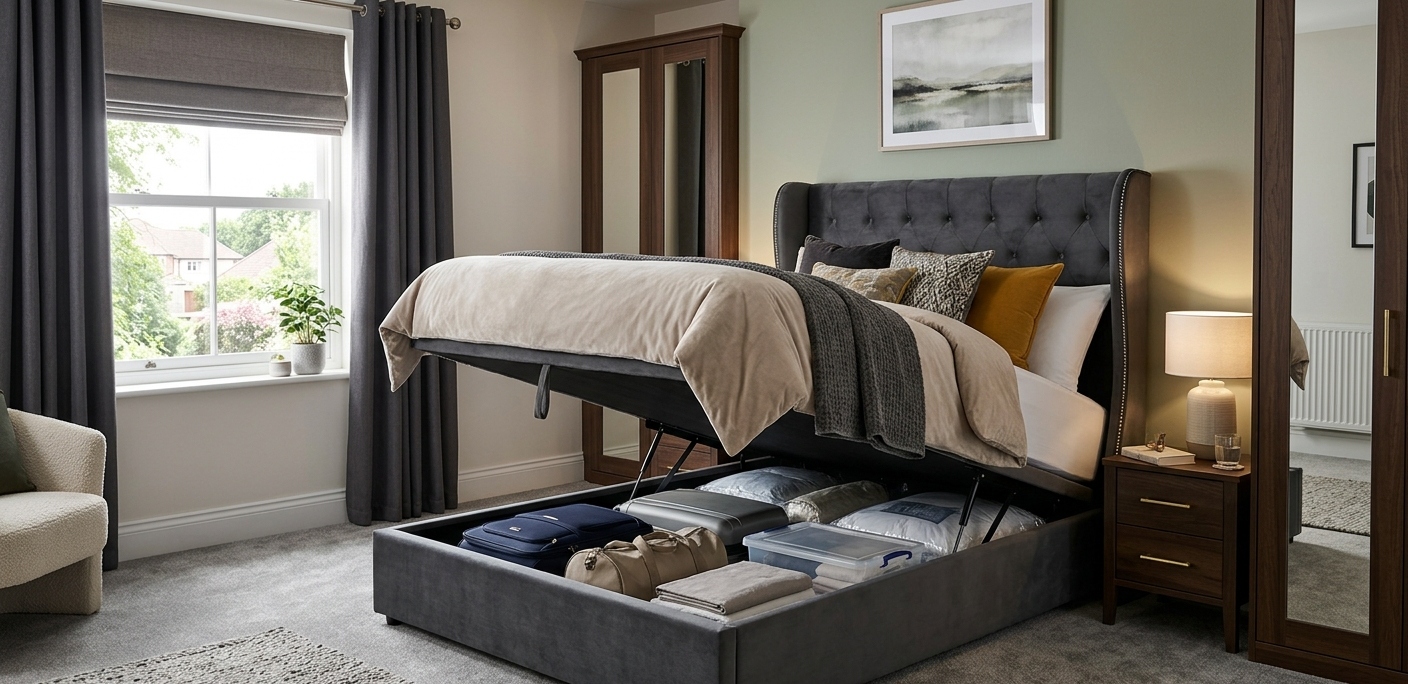
An ottoman bed is a bed with a built-in gas-lift storage system underneath the mattress. Instead of pull-out drawers on the sides, like a divan bed, the entire mattress lifts upward, supported by gas pistons, to reveal one large, open storage space beneath.
The storage area runs the full length and width of the bed base. There are no dividers, no compartments, and no size restrictions on what you can put inside. Suitcases, bulky duvets, seasonal clothing, spare bedding, sports equipment—all of it fits in a way that drawer-based storage simply cannot match.
Ottoman beds have been popular in European homes for decades, and they’ve seen enormous growth in the UK market over the past several years, driven largely by the reality that UK homes, particularly flats and new builds, are getting smaller while the need for storage keeps growing.
According to the Office for National Statistics, average UK home sizes have decreased significantly over the past three decades, making efficient use of bedroom space more important than ever. An ottoman bed is one of the most effective responses to that challenge.
Why Choose a King Size Ottoman Bed?
Of all the ottoman bed sizes available, the king size ottoman bed is consistently the most popular in the UK, and for very good reasons.
A king size bed measures 150cm wide by 200cm long. That’s 15cm wider than a standard double, which makes a meaningful difference to how comfortable two people sleeping together actually feel. Many couples who upgrade from a double to a king size ottoman bed describe it as one of the best bedroom decisions they’ve ever made.
But the size advantage goes beyond just sleeping space.
A king size ottoman bed also offers substantially more storage than its double counterpart. The under-bed area of a king ottoman typically provides around 600–800 litres of usable storage, enough for multiple suitcases, a full set of seasonal bedding, extra pillows, and more, all in a single space that closes completely out of sight.
For couples in a main bedroom, particularly in a home without a loft, with limited wardrobe space, or in a flat where storage is genuinely scarce, a king size ottoman bed isn’t a luxury. It’s a practical solution to a very real everyday problem.
Ottoman Bed Sizes: Which Is Right for You?
Before you fall in love with a particular style or fabric, make sure the size you’re considering actually works for your room. Here’s a complete guide to every standard UK ottoman bed size.
Single Ottoman Bed (90 × 190cm)
The smallest option, best for children’s rooms, teenager’s bedrooms, or compact spare rooms. Single ottoman beds offer less storage than larger sizes but still significantly more than a standard slatted frame. A good choice when the room is small but storage is still needed.
Room size needed: At least 2.5m × 3m for comfortable use.
Small Double Ottoman Bed (120 × 190cm)
An underrated size that works brilliantly for guest rooms and single adults who want more sleeping space than a standard single provides. The small double ottoman offers a useful storage upgrade over a single while maintaining a smaller footprint than a full double.
Room size needed: At least 3m × 3.5m.
Double Ottoman Bed (135 × 190cm)
The most common starting point for couples. A double ottoman bed offers excellent storage and comfortable sleeping space for two people in a standard UK double bedroom. It’s a well-rounded choice that works in most room sizes.
Room size needed: At least 3m × 3.5m, ideally 3.5m × 4m for comfortable movement around the bed.
King Size Ottoman Bed (150 × 200cm)
The most popular ottoman bed size in the UK for main bedrooms. A king size ottoman bed gives couples significantly more sleeping space than a double, a longer mattress (200cm vs 190cm), and the largest storage capacity available at a mainstream price point.
Room size needed: At least 3.5m × 4m. Ideally 4m × 4.5m for full comfort and opening clearance.
Super King Ottoman Bed (180 × 200cm)
The premium option, 30cm wider than a king and the ultimate in sleeping space. Super king ottoman beds are best suited to large main bedrooms where space genuinely allows. The storage capacity is impressive, but the room needs to be able to accommodate the full mattress lift without obstruction.
Room size needed: At least 4m × 5m.
Opening Types Explained: End-Opening vs Side-Opening
This is the detail that catches most first-time ottoman bed buyers out, and getting it wrong is an expensive mistake.
End-Opening Ottoman Bed
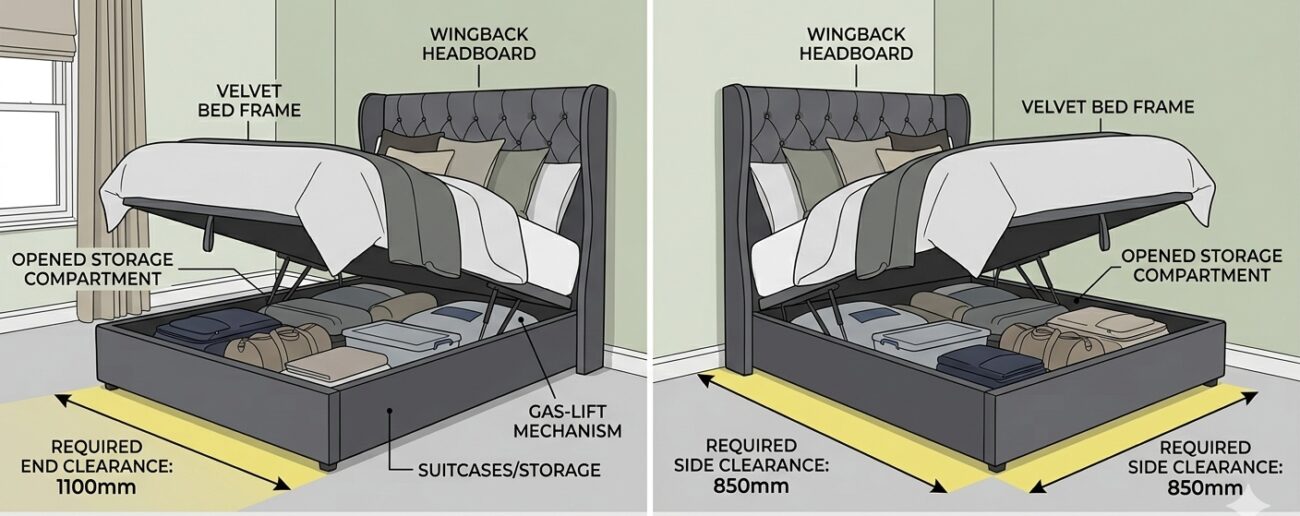
The mattress lifts from the foot end of the bed, swinging upward toward the wall at the head end.
Choose end-opening if:
- The head of your bed is against a wall (very common in UK bedrooms)
- Both sides of the bed have furniture or limited clearance
- You have clear space at the foot of the bed, at least 60–80cm beyond the bed’s length for the mattress to lift without obstruction
Avoid end-opening if:
- A wardrobe, chest of drawers, or wall is close to the foot of the bed; the mattress cannot lift if the path is blocked
Side-Opening Ottoman Bed
The mattress lifts from one side, usually the left or right, specified at purchase, swinging upward away from the chosen side.
Choose side-opening if:
- The foot of the bed is close to a wall or furniture (e.g., built-in wardrobe)
- You have clear space on one side of the bed, at least 60–70cm of clearance for the mattress to open
- One side of the bed is regularly accessible and the other is against a wall
Avoid side-opening if:
- Both sides of the bed are tight to walls or furniture
Key rule: Before you order any ottoman bed, stand in your bedroom and physically assess where the mattress can go when lifted. Measure the clearance. This single step prevents the most common ottoman bed buying mistake.
Gas Lift Mechanism: How It Works and What to Look For
The gas lift mechanism is the heart of any ottoman bed, and understanding what makes a good one helps you avoid buying a poor one.
How it works: Gas pistons are attached between the bed base and the mattress platform. When you apply gentle upward pressure to the mattress or a designated lift handle, the compressed gas in the pistons extends, taking the weight of the mattress and holding it open at a stable angle. To close, you pull the mattress back down, the pistons compress smoothly, and the base closes quietly.
What to look for in a quality mechanism:
- Piston rating: Quality gas pistons are rated for thousands of open-and-close cycles, typically 10,000 or more. Ask your retailer about the piston specification if it isn’t stated.
- Smooth, controlled lift: The mattress should open with minimal effort and stay fully open without any tendency to drop. A good mechanism feels controlled in both directions.
- No sudden drops: The mattress closing should be smooth and gentle, not dropping under its own weight. A mechanism that closes too quickly is a safety concern, particularly in homes with children.
- Warranty coverage: According to Which?, a manufacturer warranty of at least 2 years on the lift mechanism is a reliable baseline quality indicator. Better products often carry 3–5 year guarantees.
Fabrics and Finishes: Choosing the Right Look
The fabric of your ottoman bed base has a bigger impact on the overall look of your bedroom than most people initially realize. Here’s a guide to the main options and what each one offers.
Velvet
Rich, plush, and unmistakably luxurious, velvet is consistently one of the most popular fabric choices for king size ottoman beds in the UK. It catches light beautifully and adds genuine warmth and depth to a bedroom.
Best colours: Midnight blue, forest green, charcoal grey, dusty pink, and deep teal all look stunning in velvet.
Practical note: Velvet can show marks and directional light changes (known as crushing) with regular contact. A lint roller and occasional brushing keeps it looking its best.
Linen and Woven Fabric
A more understated, natural-looking option. Linen and woven fabrics suit Scandinavian, neutral, and minimalist bedroom styles particularly well. They tend to be slightly more forgiving of everyday wear than velvet.
Best colours: Stone, natural oat, warm grey, and soft cream.
Chenille
Chenille sits between velvet and woven fabrics in terms of texture, softer than a plain weave but more structured than velvet. It’s a hardwearing fabric that looks good for longer with regular use.
Best colours: Silver grey, mink, and warm taupe are particularly popular.
Faux Leather and PU
A contemporary option that suits modern and industrial bedroom aesthetics. Easy to wipe clean, a practical consideration in homes with young children. Less traditional than fabric options but increasingly popular for contemporary UK interiors.
What to Store in an Ottoman Bed
One of the most common questions buyers ask is: what can I actually store in there?
The honest answer is: a lot.
Here’s what fits comfortably in a standard king size ottoman bed storage area:
- 2–3 large suitcases (the kind that go in an aeroplane overhead locker, not just cabin bags)
- A full winter duvet plus spare duvet covers, pillow cases, and fitted sheets
- Seasonal clothing, bulky jumpers, coats, and items you only need part of the year
- Extra pillows, the decorative ones you remove at night
- Sports equipment, yoga mats, resistance bands, and compact gym gear
- Children’s extra bedding, for overnight guests or sleepovers
- Books, magazines, and other flat items stacked along the base
What doesn’t work well: heavy items that are awkward to lift in and out (the mattress opens wide but you’re still reaching down), or loose small items that scatter when the base is opened.
The Sleep Council UK recommends keeping bedrooms as clutter-free as possible for better sleep quality, and a king size ottoman bed is one of the most effective tools available for achieving exactly that.
How to Measure Your Bedroom for a King Size Ottoman Bed
Getting the sizing right before you order saves considerable stress later. Here’s the step-by-step process.
Step 1: Measure the floor space. Measure the full length and width of your bedroom. For a king size ottoman bed (150 × 200cm), you need at least 3.5m × 4m of total floor space for comfortable use, and ideally 4m × 4.5m.
Step 2: Decide bed placement. Mark on your measurements where the bed will sit. Most UK bedrooms place the bed centrally against the main wall, usually opposite the door.
Step 3: Check opening clearance. Depending on whether you choose end-opening or side-opening, measure the clearance available at the foot or side:
- End-opening: At least 60–80cm beyond the foot of the bed
- Side-opening: At least 60–70cm on the opening side
Step 4: Allow movement space. Leave at least 60cm on both sides of the bed for comfortable movement, getting in and out, making the bed, and general everyday use.
Step 5: Check door and staircase access. Ottoman bed bases split into two sections for delivery. Measure your doorway width (at least 60cm needed), hallway width, and any staircase turns. Most UK deliveries go smoothly, but it’s worth confirming before your delivery date.
Common Mistakes to Avoid When Buying an Ottoman Bed
- Not checking opening clearance. The single most common mistake, and the most avoidable. Measure your room before you order, every time.
- Choosing the wrong opening direction. End-opening and side-opening are not interchangeable. Map your room layout and choose based on where you actually have space, not preference alone.
- Buying based on price alone. A cheap gas-lift mechanism will fail faster and feel less controlled. Quality gas pistons cost more to manufacture; that cost is reflected in the price for a reason.
- Forgetting to budget for a headboard. Many ottoman beds are sold as base only; the headboard is separate. Factor this into your total budget before you browse.
- Ignoring fabric practicality. A beautiful velvet ottoman looks stunning, but if you have pets or young children, consider how the fabric will handle real daily life before committing.
- Not checking the warranty. A quality king-size ottoman bed should come with at least a 2-year guarantee on the mechanism. If a retailer can’t tell you the warranty terms, shop elsewhere.
Buying Tips Before You Order
A few final practical points that make a genuine difference:
- Order your ottoman base and mattress together; many retailers offer bundle savings, and sizing is simpler when bought from the same place.
- Request a fabric swatch before ordering; colours look different on screen than in real life.
- Confirm delivery specifics; check whether delivery is kerbside, doorstep, or room-of-choice, and whether assembly is included.
- Check the returns window; for a purchase at this price point, a reasonable returns policy matters.
- Read reviews specifically mentioning the gas lift; this is the component most likely to vary in quality, and real customer feedback on mechanism smoothness is more useful than product descriptions.
Internal Link Suggestions
Place internal links naturally at these points in the post:
- double ottoman bed mention: link to Double Ottoman Beds category
- ottoman bed with storage mention: link to Ottoman Beds category page
- divan bed comparison mention: link to Divan Beds category page
- Conclusion CTA: link to full Ottoman Beds collection
Conclusion: The Right Ottoman Bed Is Worth Every Penny
An ottoman bed, and a king-size ottoman bed in particular, is one of the most genuinely useful pieces of furniture you can put in a UK bedroom.
It solves the storage problem that most UK homes face without adding a single extra piece of furniture to your floor plan. It provides excellent mattress support. It looks clean, contemporary, and considered. And it improves daily bedroom life in small but consistent ways that add up significantly over years of use.
The key is buying the right one, the right size, the right opening direction, the right fabric, and the right quality mechanism.
Take your time. Measure your room.
Choose the opening type that actually works for your layout. And invest in quality where it counts, the gas lift mechanism above everything else.
Ready to find yours? Visit our full King Size Ottoman Bed collection at Appex Beds, premium upholstered options in every size, with free UK mainland delivery on every order.
Frequently Asked Questions
What size room do I need for a king size ottoman bed?
A king size ottoman bed (150 × 200cm) needs at least 3.5m × 4m of total bedroom floor space for comfortable use. Allow at least 60cm on both sides of the bed for movement, and either 60–80cm at the foot (end-opening) or 60–70cm on one side (side-opening) for the mattress to lift fully. Ideally, a room of 4m × 4.5m gives you comfortable space for a king ottoman with good access all around.
Is a king size ottoman bed difficult to use?
Not at all. The gas pistons do the heavy lifting, literally. A gentle upward push on the mattress is all that’s needed to start the lift, and the pistons take over from there. The mattress stays fully open at a stable angle while you access storage, then lowers smoothly and gently when you bring it back down. Most people find it becomes second nature within a few days of use.
Can I use any mattress on a king size ottoman bed?
Yes, king size ottoman beds are compatible with all standard UK mattress types, including memory foam, pocket sprung, hybrid, orthopaedic, and latex. The mattress weight does affect how the gas pistons perform, some manufacturers specify a recommended mattress weight range for their mechanism. Always check this if you have a particularly heavy specialist mattress.
How much storage does a king size ottoman bed provide?
A standard king size ottoman bed provides approximately 600–800 litres of usable under-bed storage, equivalent to several large suitcases plus a full set of bedding. The exact volume varies by specific product and base depth. This is substantially more than the 150–250 litres typically provided by a divan bed with 4 standard drawers.
What is the difference between end-opening and side-opening ottoman beds?
End-opening ottoman beds lift from the foot of the bed, best when the head is against a wall and the foot has clear space. Side-opening beds lift from one side, best when the foot is restricted but one side has clearance. The choice should be based entirely on your bedroom layout and where you have sufficient clear space for the mattress to open fully. Getting this wrong is the most common ottoman bed buying mistake.