
Blog
Divan Bed Assembly Guide:Step-by-Step Instructions

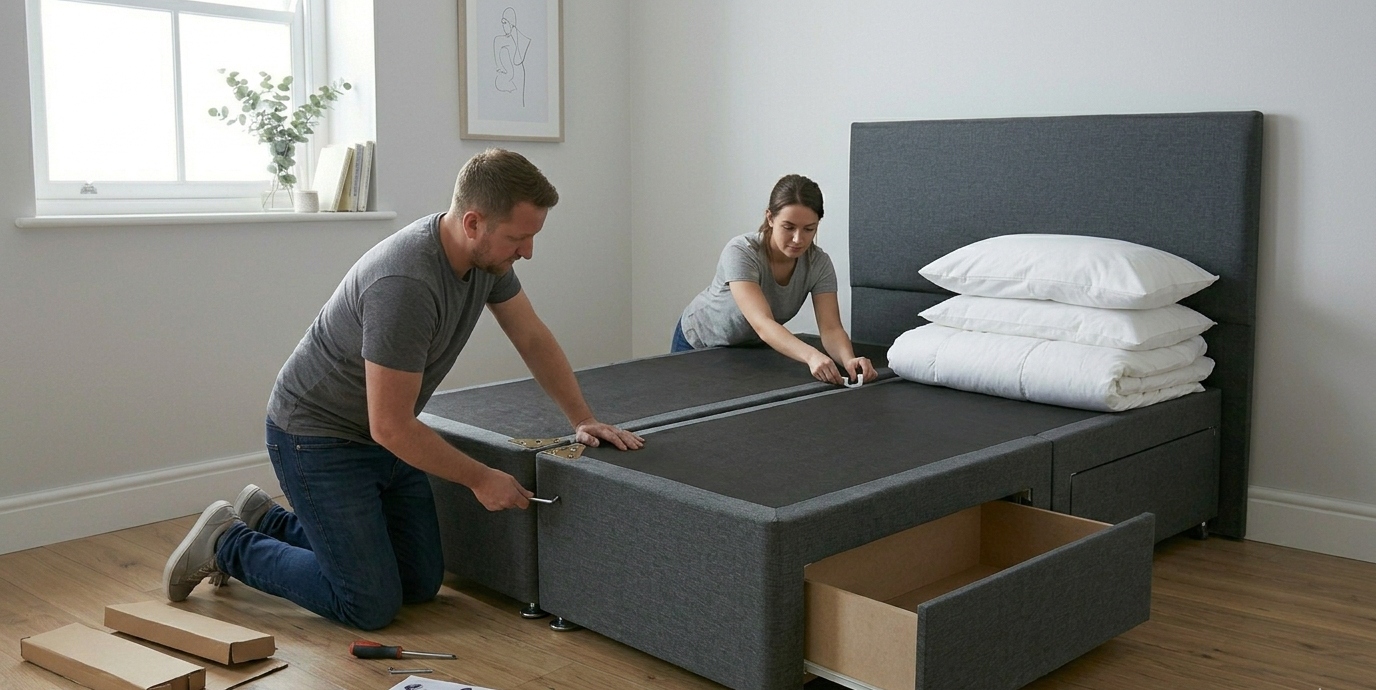
Your new divan bed has arrived. It’s sitting in boxes in your hallway, or halfway up your staircase, more likely, and you’re looking at it wondering where to begin. Good news: assembling a divan bed is genuinely one of the easier furniture jobs you’ll encounter. There are no complicated joints, no Allen keys disappearing into carpet never to be found again, and no instruction manual that seems to have been translated from another language by someone who’s never seen a bed. Most divan beds go together in under 30 minutes. Some take less. But there are a few things worth knowing before you start, especially if yours has divan bed storage drawers, a gas-lift ottoman base, or a headboard to attach. Getting those details right from the beginning saves you having to take things apart and start again. This guide walks you through the whole process, step by step. Clearly, simply, and in the right order.
What You’ll Need Before You Start
One of the great things about assembling a divan bed is that you don’t need much. Unlike flat-pack furniture that seems to require a toolkit the size of a small toolbox, most divan bases are designed to go together with minimal tools. Here’s what to have nearby before you open any boxes:
- Another person, not technically a tool, but genuinely essential. Divan base sections are manageable but awkward to manoeuvre alone, especially in tight spaces. Don’t attempt it solo if you can avoid it.
- A clear space, move other furniture out of the way before you start. You need room to work, room to lay sections flat, and room to move around the bed as you build it.
- A screwdriver, flathead and Phillips, just in case. Most divan beds don’t require any tools at all, but headboard struts sometimes need a screwdriver to tighten.
- The instruction sheet, find it before you open everything else. It should be inside one of the boxes, usually tucked flat against a base section.
- Your phone, take a photo of the boxes and labels before you open them. If anything seems missing or damaged, you’ll want that documentation.
Step 1: Open and Check Everything First
Before you assemble anything, open all the boxes and lay everything out. A standard divan bed delivery typically includes:
- Two base sections (the divan base splits into two halves for easy delivery and manoeuvring)
- Castors or legs (usually already attached or in a small bag)
- A headboard (if included in your order)
- Headboard struts (the metal brackets that attach the headboard to the base)
- Drawers (if your bed has divan bed storage, these are usually packed flat inside or beneath the base sections)
- Any fixings, bolts, or connector pieces
Check everything against the parts list in your instruction sheet. Do this before anything is assembled. If something is missing or damaged, contact your retailer immediately; it’s much easier to resolve before the bed is built.
Step 2: Attach the Castors or Legs
Most divan bases arrive with either small castors (wheels) or short fixed legs that need to be attached to the underside of each base section.
For castors: You’ll usually find pre-drilled holes on the underside of the base at each corner and sometimes in the middle. Castors typically twist or push directly into these holes, no tools required. Give each one a firm push until it clicks or locks into place.
For fixed legs: These usually screw directly into the pre-drilled holes using a thread already built into the leg. Hand-tighten until firm, no need to over-torque these.
Important: Attach all castors or legs to both base sections before you stand either section upright. It’s much easier to do this while the base is still flat on the floor or carpet. If your bed has divan bed storage drawers, check that the castors on the drawer side of the base are positioned so they don’t obstruct the drawer opening later. The instruction sheet should confirm exactly where each castor goes.
Step 3: Position the First Base Section
Once the castors or legs are attached to both sections, bring the first base section into the bedroom and position it roughly where the finished bed will sit. A few things to think about at this stage:
- Drawer access: If your divan has divan bed storage drawers, position the base so the drawer side faces outward into the room, away from any wall. Drawers need clear space to open fully, so make sure there’s at least 50–60cm of clearance on the side where they open. Don’t position the bed against a wall on the drawer side.
- Headboard wall: Position this first section so the top of the base is close to, but not yet touching, the wall where the headboard will eventually rest.
- Mattress orientation: Think about which side of the bed each person sleeps on, and position accordingly. It’s much easier to adjust this now than after everything is assembled.
Step 4: Connect the Two Base Sections
This is the step that surprises most people the first time; divan bases connect together using a simple linking system, and it genuinely takes about 30 seconds.
Most UK divan beds use one of two connection methods:
- Link bar connector: A flat metal bar that slots into a channel or bracket on the inner edge of each base section, holding them together. Slide the bar into one section first, then push the second section up against the first so the bar slots into the corresponding bracket on the other side.
- Bolt connector: Some bases use a bolt and nut system through the joining face of each section. Insert the bolt from one side, pass it through the pre-drilled hole in the second section, and hand-tighten the nut on the other side.
Either way, once connected, the two sections should sit flush against each other with no visible gap down the middle. Run your hand along the join; it should be flat and level. Check before moving on: Gently push and pull the connected sections. They should feel solid and stable. If there’s any movement at the join, re-check the connector is fully engaged before proceeding.
Step 5: Install the Divan Bed Storage Drawers
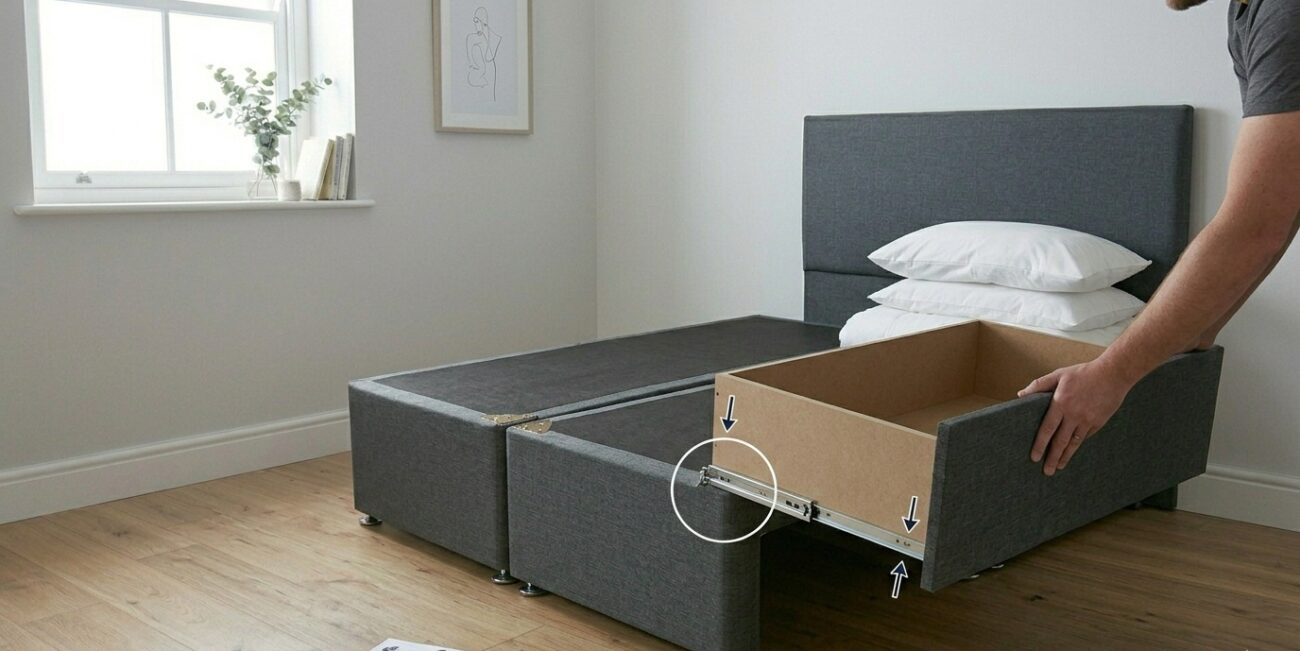
If your bed includes divan bed storage drawers, now is the time to fit them, before the mattress goes on. Most divan drawers work on a simple runner system built into the base. Here’s how to fit them correctly:
- Locate the drawer openings: On the side of the base, you’ll see one or more rectangular openings where the drawers slide in. Some bases have two openings on each side (4-drawer model), some have one per side (2-drawer model).
- Align the drawer runners: Most divan drawers have small plastic or metal runners on the underside or sides of the drawer body. These align with corresponding channels inside the base opening.
- Slide the drawer in: Push the drawer straight into the opening, keeping it level. You should feel it engage with the runner system inside the base. Push it gently until it’s fully inside and the drawer front sits flush with the side of the base.
- Test each drawer: Pull it out smoothly and push it back in. A properly fitted drawer should glide without sticking, catching, or tilting. If it feels stiff or uneven, remove it and check the alignment of the runners before reinserting.
- For continental drawers: These larger, deeper drawers follow the same process but are heavier. Have your second person help with these; the extra weight makes alignment trickier to manage alone.
Once all drawers are fitted and tested, you’re ready for the next step.
Step 6: Place the Mattress
With the base fully connected and all divan bed storage drawers fitted and tested, the mattress goes on next. This is where having two people makes the biggest difference. Mattresses, especially pocket sprung, hybrid, and orthopaedic versions, are heavy and awkward. Don’t try to wrestle one up a staircase or into position alone.
Positioning: Lower the mattress onto the base with the correct orientation. Most mattresses have a top and bottom side (check the label; it often says “this side up” or shows a sleeping figure). Some memory foam mattresses are one-sided; others can be flipped.
Alignment: The mattress should sit flush with all four edges of the base. No overhang on any side. If the mattress is slightly smaller than the base (which can happen with some non-standard sizes), centre it so the gap is equal on both sides.
Mattress protector: If you have one, and you should, because a good mattress protector significantly extends mattress life, fit it now before the headboard goes on. It’s much easier to tuck and fasten a mattress protector before the headboard is in place.
Step 7: Attach the Headboard
The headboard is the finishing touch that transforms a plain divan base into a complete, properly dressed bed. Here’s how to attach it correctly:
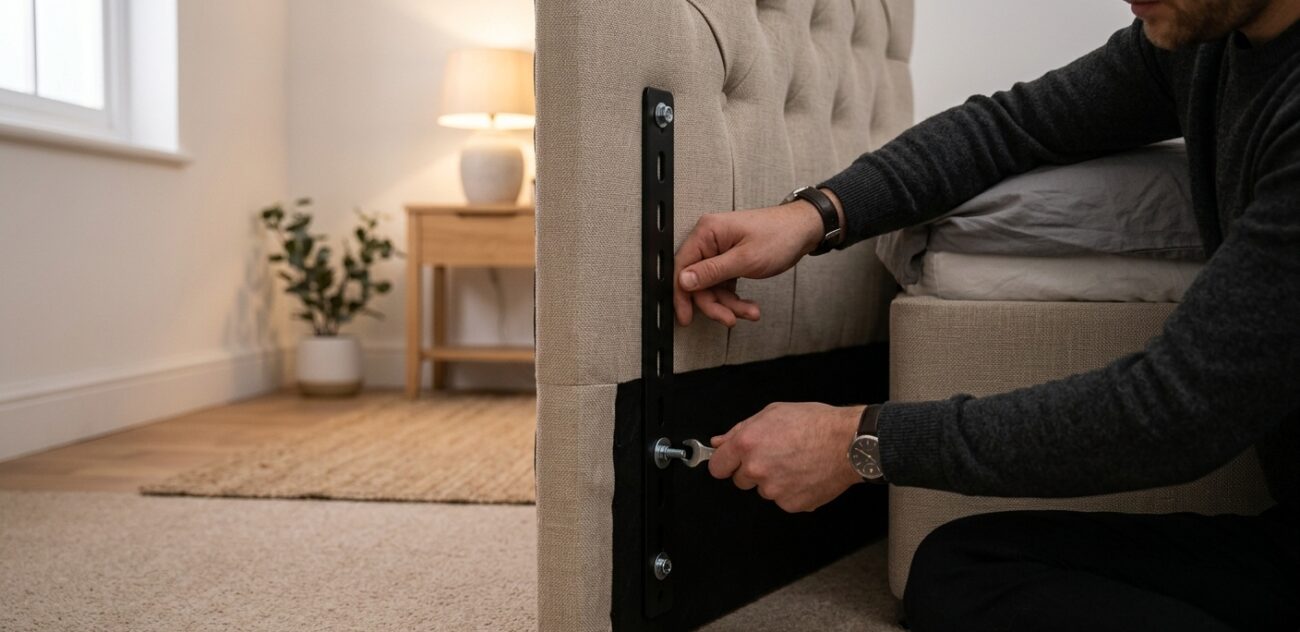
- Locate the strut holes: On the back face of the top section of the base, you’ll find two rectangular slots or holes; these are the headboard strut fixing points. They’re usually positioned symmetrically, one towards each end of the base top.
- Attach the struts to the headboard: The headboard struts (the long, flat metal brackets) bolt onto the back of the headboard itself, usually through pre-drilled holes. Tighten the bolts firmly by hand, then give them a final quarter-turn with a screwdriver if needed.
- Insert struts into the base: Slide the bottom of each strut down into the corresponding slot on the top of the base. The struts should drop in and sit firmly; they’re held by gravity and the weight of the headboard itself, so no additional fixing is usually required.
- Check height and stability: Stand back and check the headboard looks level. Give it a gentle push and pull; it should feel solid. If it wobbles, check that both struts are fully seated in their slots.
- Height adjustment: Many headboard struts have multiple holes that allow you to adjust the height the headboard sits at above the base. If your headboard looks too low or too high, remove the struts and reattach them at a different hole position.
Step 8: Final Checks Before Bedding Goes On
Before you make the bed up with bedding, run through these final checks. They take two minutes and save potential frustration later.
- Test every drawer one more time: Open and close each drawer fully. They should glide smoothly with no catching or resistance. If any drawer has started to stick since fitting, check whether the base has shifted slightly on the floor; sometimes repositioning the base on even ground resolves this.
- Check the base join: Look at the line where the two base sections meet. It should be flush across the top surface. If there’s a slight ridge, adjust the connecting bar or bolt until both sections sit level.
- Check the headboard: Push the headboard gently from side to side and front to back. It should feel solid and stable with no wobble.
- Check the castors or legs: Get down and look underneath. Every castor or leg should be making contact with the floor. If one is raised, the base may be sitting on an uneven patch of floor; repositioning it a few centimetres usually solves this.
- Clear the drawer clearance: Open every drawer fully and check there’s nothing blocking the path, no bedside table too close, no rug that the drawer catches on. If anything is in the way, adjust your furniture layout now.
Common Assembly Mistakes, and How to Avoid Them
Even with a simple product like a divan bed, a few mistakes come up time and again. Here’s what to watch for:
- Fitting castors after standing the base up. It sounds minor, but trying to fit castors to a base that’s already upright is genuinely awkward. Always attach them while the base sections are flat.
- Connecting the sections before fitting the drawers. Some people connect the base halves first and then try to fit the drawers, only to find the drawer openings are partially blocked by the floor and the join. Fit the castors first, connect the sections, then slide the drawers in while there’s clear access from the side.
- Placing the drawer side against the wall. A divan bed storage system is completely useless if the drawers can’t open. Always check clearance before you finalise the bed position.
- Over-tightening headboard bolt connections. Tighten firmly, not aggressively. Over-tightening can strip the thread in the headboard fixings, which is a difficult problem to resolve once it’s happened.
- Not checking the mattress orientation. Some mattresses have a designated top side; putting them on the wrong way up wastes the specific comfort layers designed to face upward.
Care Tips to Keep Your Divan Bed in Great Condition
Assembly done, now make it last:
- Rotate your mattress regularly. Even on a solid divan base, rotating your mattress 180 degrees every three to six months helps it wear evenly and extend its lifespan. If it’s double-sided, flip it too.
- Clean the drawer runners occasionally. A light wipe with a dry cloth keeps drawer runners free from dust and debris that can cause sticking over time.
- Don’t overload the drawers. Divan bed storage drawers are designed for bedding, clothing, and similar items, not as a second loft. Overloading puts stress on the runners and the base structure. Be sensible about what goes in.
- Vacuum underneath regularly. Even though a divan base sits close to the floor, dust still accumulates along the edges. A quick vacuum around the base every month keeps things fresh.
- Check the connector periodically. Once a year, check the base connector bar or bolt is still firmly in place. Slight loosening can develop over time; a quick hand-tighten is all it usually needs.
Conclusion: Simple When You Know How
Assembling a divan bed, even one with divan bed storage drawers and a headboard, is a genuinely straightforward job when you follow the steps in the right order. Attach the castors first. Connect the sections. Fit the drawers. Place the mattress. Attach the headboard. Check everything. Done.
From unpacking to finished bed, most people complete the whole process in 20 to 40 minutes. And once it’s together, a well-made divan base with storage will serve you reliably every single day for years to come.
If you haven’t yet chosen your divan bed, or you’re thinking about upgrading your current setup, browse our full range at Appex Beds, every bed comes with clear assembly guidance, free UK mainland delivery, and a team ready to help if you have questions before or after your order.
Frequently Asked Questions
How long does it take to assemble a divan bed?
Most divan bed assemblies take between 20 and 40 minutes with two people. The process is straightforward: the base connects in two sections, drawers slot in without tools, and headboards attach via simple strut brackets. Having a second person significantly speeds up the process, particularly when positioning the mattress.
Do I need tools to assemble a divan bed?
In most cases, no. The majority of UK divan bed assemblies require no tools at all; castors push in, base sections connect via a link bar, and drawers slide straight in. A Phillips screwdriver can be useful for tightening headboard strut bolts, and it’s worth having one nearby, but many headboards attach without any tools either.
Can I assemble a divan bed by myself?
Technically yes, but it’s not recommended, particularly when placing the mattress and manoeuvring the base sections into position. The base sections themselves are manageable but awkward alone. The mattress, especially heavier pocket sprung or hybrid designs, is genuinely difficult and potentially risky to carry and position without a second person.
Why won’t my divan storage drawers slide smoothly?
Sticking drawers are almost always caused by one of three things: misaligned runners (remove the drawer and reinsert it carefully, checking the runners are engaged correctly), the base sitting on uneven flooring (repositioning the bed slightly usually resolves this), or debris on the runner track (a dry cloth wipe clears most obstructions). If drawers were smooth at first and have become stiff over time, check the base connector is still tight; a loose join can cause the base to flex slightly under load, which affects drawer alignment.